Happy that our paper on Twitch’s community gifting feature has finally found a home at Journal of Interactive Marketing! Community gifting is a digital artifact that enables a gifter to donate digital goods to peers without selecting specific recipients. On Twitch, community gifts are manifested as streamer subscriptions purchased by a viewer that are “randomly” allocated among community members by the platform (see screenshot below). While these gifts represent an incremental revenue stream, perhaps by lowering the inhibitions to gifting by removing the awkwardness of specifying a recipient, they may also impact behaviors of recipients. In this paper, coauthors Alex Chaudhry (SUU) and Erya Ouyang (4th year PhD candidate at Temple who started working on this project in her first year) and I document the social and financial engagement impact of receiving a community gift during a Twitch1 livestream.
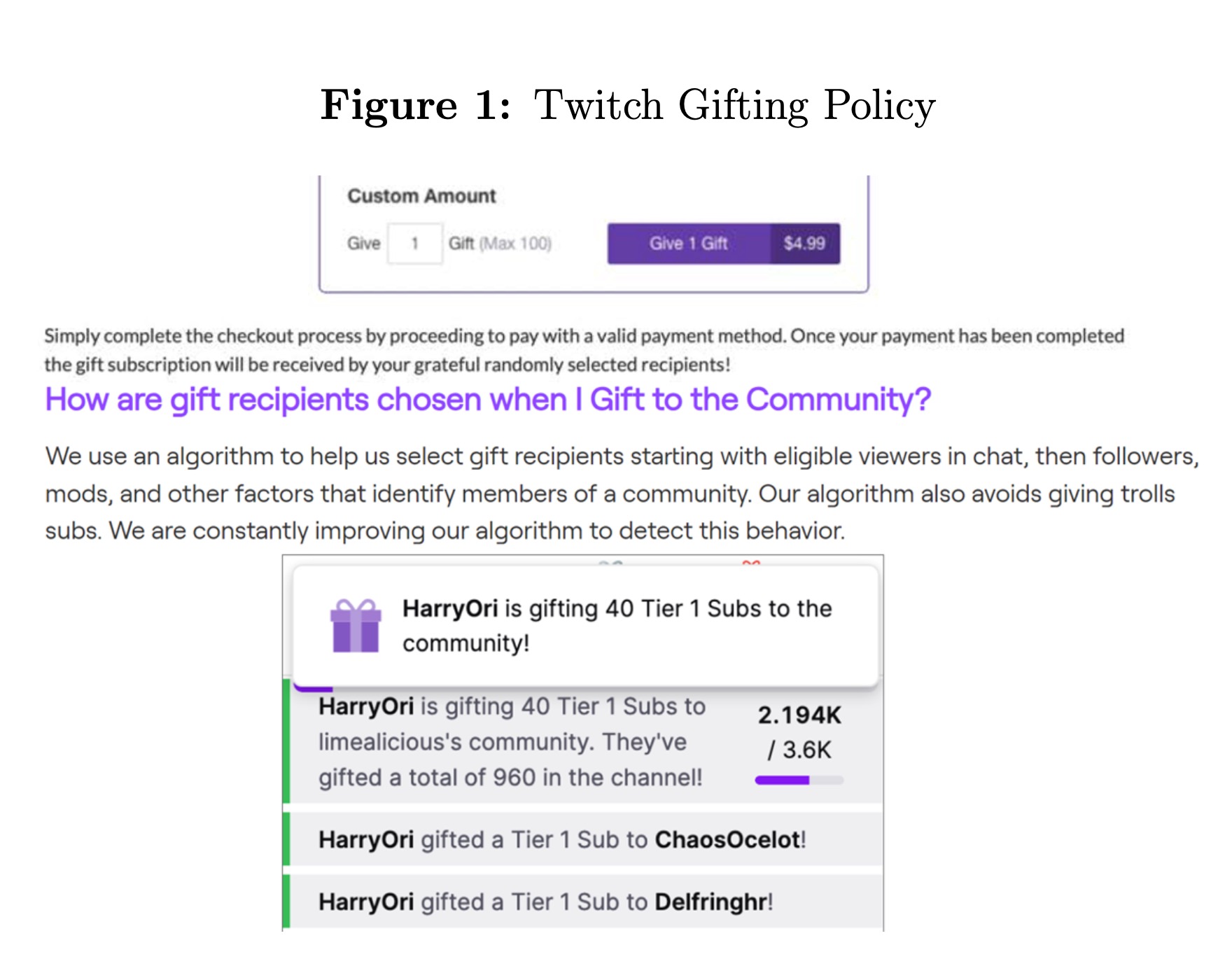
There is an extensive literature in sociology (and even biology) that studies gifting and reciprocating behaviors. The novel aspect of community gifting is the disassociation between the gifter and selection of the recipient. We wondered whether reciprocation really requires the bond that might form from knowing that the gifter explicitly chose the recipient. Taking advantage of the randomization of recipients (we check that the evidence is consistent with randomized recipient selection conditional on “being in the livestream”), we compare recipients to non recipients’ chatting and spending behaviors after community gifting events (we check that non-recipients exhibit no “spillover” effects relative to ineligible viewers).
We classify gift receipt spillovers into 4 categories: social engagement with peers (directed @ a username), social engagement with the streamer (undirected chat), financial engagement with peers (subscription gifting), and financial engagement with streamer (tipping). The figure below represents the model-free patterns across nearly 600k community gifting events. We show that the receiving a community gift increases the propensity to chat with both peers and streamers, but only impacts financial engagement with peers. Our explanation is that the the feelings of indebtedness drives financially costly reciprocity. In this case, indebtedness only exists in the recipient-community relationship because the recipient benefited (by luck) at the expense of non-recipients (and not the streamer). On the other hand, social reciprocity occurs because of elevated mood, which affects engagement with all parties.
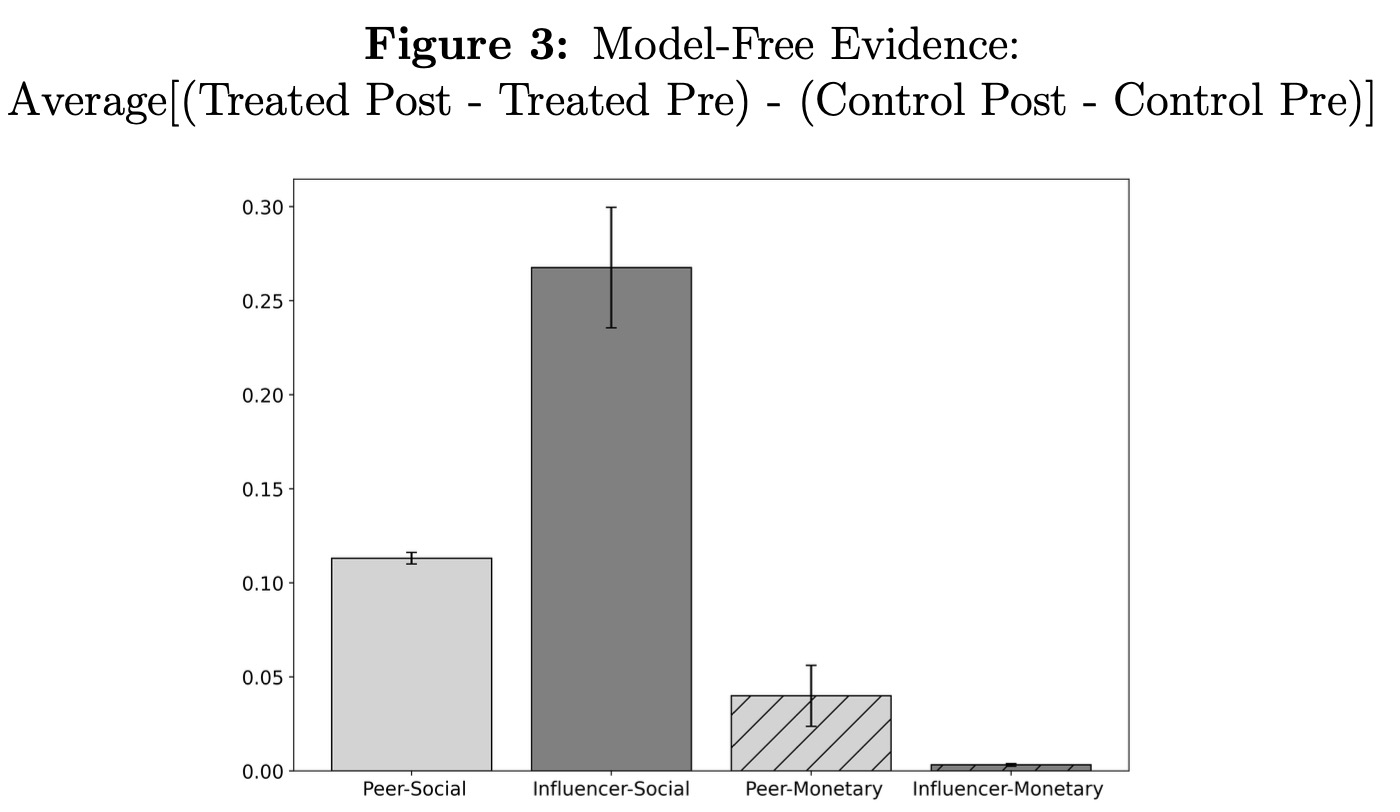
In the paper, we use a stacked DID approach to statistically evaluate the engagement spillovers of receiving a community gift. We find that community gift recipients, relative to non-recipients, exhibit a 69% chance of directing an additional message toward their peers, a 35% chance of directing an additional message toward the streamer and a 5% chance of gifting an incremental subscription to the community. However, there are no differences in tipping.
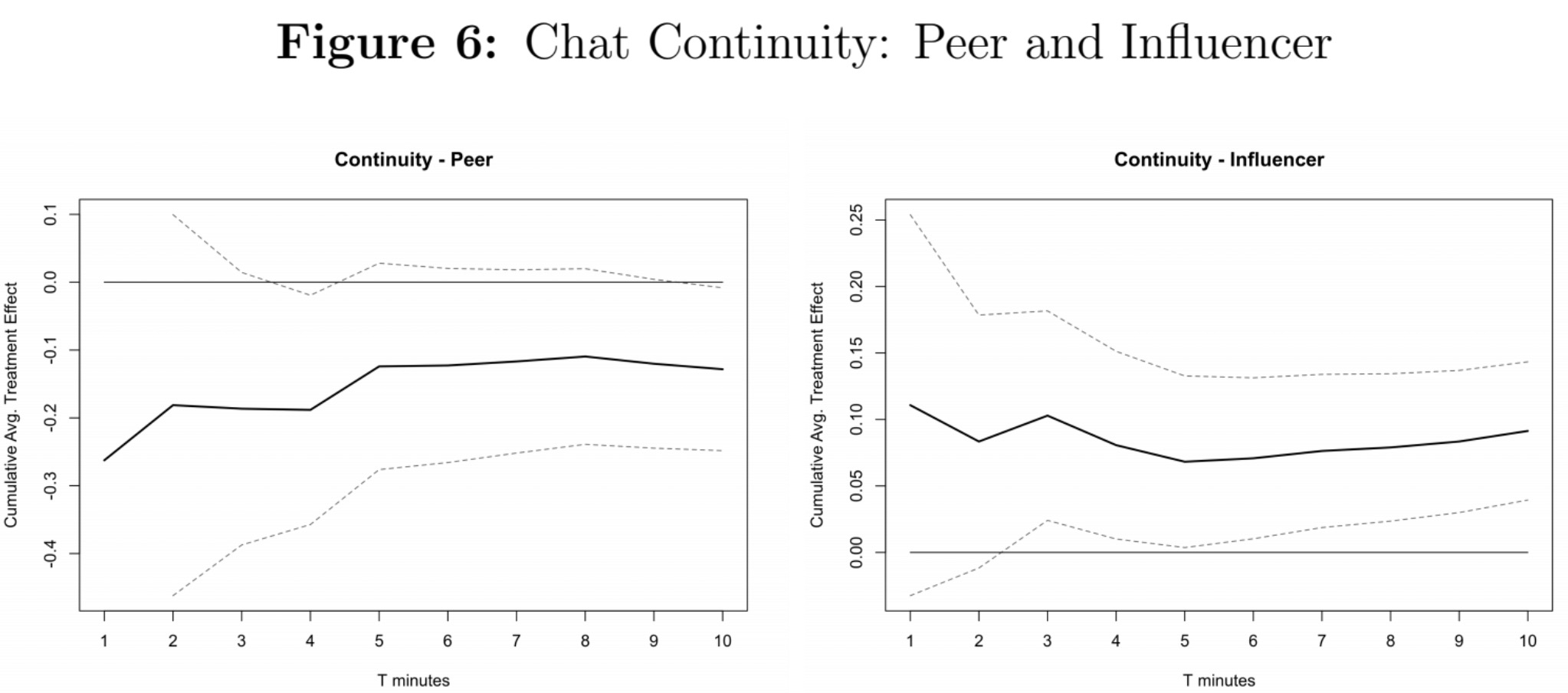
In addition to the analysis on the quantitative engagement metrics, we also tested the impact of community gifting on that qualitative aspects of social engagement. We predicted that gift recipients’ chat could exhibit more positive sentiment and continuity. While sentiment is a proxy for emotional state (joy/happiness), we argue that continuity proxies for cognitive engagement. In this study, we define chat continuity as the similarity in the W2V embedding space between a new message and the prior messages over a fixed lookback window. The evidence suggests that both predictions hold, although the continuity prediction holds in a more nuanced way. While continuity increases for streamer-directed chat, peer-directed chat decreases in continuity. This is because incremental peer-directed chat starts between the recipient and the gifter, initiating a new conversation between the dyad. However, the recipient simultaneously joins the ongoing conversation about the stream as a result of their increased cognitive engagement.
In the last part of the paper, we look at stream characteristics for which the engagement effects on the recipient increases/decreases. We find that with increased volume of prior subscription gifting during the stream decreases the likelihood that the recipient gifts additional subscriptions. This leads to a negative feedback loop wherein community gifting may beget further subscription gifting, but this effect is attenuated as overall gifting volume increases. On the other hand, we find that social engagement is even higher when the chat volume is higher and the discussion is less continuous. This creates a positive feedback loop where community gifting amplifies recipients’ engagement which further amplifies the social engagement effect of subsequent community gifts. We argue that this result is consistent with the hypothesis that a higher volume of chat with more topics makes it easier for recipients to join the ongoing conversations.
This was a super fun project to work on and I learned a lot about livestreaming culture and internet slang after watching many hours of livestreams. My favorite streamer was SangahNoona who is unfortunately no longer active on Twitch, but still active on Youtube, and I did my fair share of community gifting just to see if our findings were consistent with my own anecdotal experience (it was!).
1 Note that the analysis of this project was completed prior to my employment at Amazon (Twitch’s parent company) and does not represent the views of Amazon nor benefited from my employment at the company.
 Dr. Yang Wang